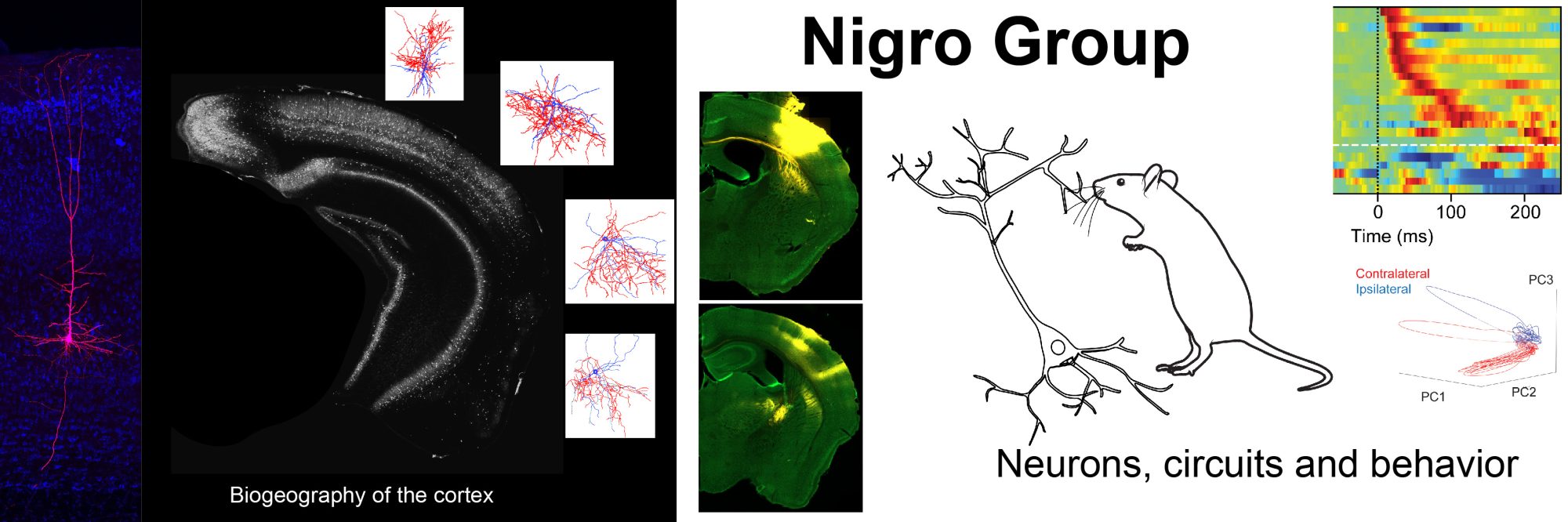
Biogeography of the cortex
Cortical neurons show a wide diversity of molecular, biophysical and morphological features. This diversity allows cortical neurons to fine tune the properties of canonical microcircuits, endowing diverse computational capabilities to different cortical areas. I am interested in the multimodal characterization of cortical cell types, the development of methods to label and manipulate them and in the study of their distribution across cortical regions. To this aim, my laboratory employs anatomical, neurophysiological and viral approaches to identify cell types and quantify their distribution across the cortex. We are actively investigating the diversity of GABAergic fast-spiking neurons across cortical regions and their contribution to sensory processing.
Neural dynamics across sensory hierarchies
The cerebral cortex is divided in many regions according to their cyto- and chemoarchitecture and connectivity. These traditional features ultimately reflect gradients of cell types or their properties (molecular, physiological, etc) across cortical regions. These gradients interact with the connectivity of these areas to produce neural dynamics that can allow gating and routing of sensory information. We are studying how the biogeography of cell types and gradients of their biophysical properties impacts neural dynamics during sensory and multisensory processing and learning.
RhinalMultiSense
This project was funded by the EuropeanUnion’s Horizon 2020 research and innovation programme under the Marie Sklodowska-Curie grant agreement No 885955. The aim of RhinalMultiSense was to study the organization of sensory inputs in the mouse perirhinal cortex. The perirhinal cortex is a cortical region situated along the lateral side of the rodent brain and in the temporal lobe in primates. It receives sensory information from all modalities and represents an interface between sensory and memory systems. Because of its role as a cortical hub, the perirhinal cortex is implicated in learning and memory, sensory processing, and object recognition. Establishing how sensory inputs are organized in the perirhinal cortex is important to understand the function of perirhinal cortex in different cognitive tasks and pathological conditions such as epilepsy, Alzheimer’s disease and autism spectrum disorders.

EmotionObjectCode
This project was funded by the EuropeanUnion’s Horizon 2020 research and innovation programme under the Marie Sklodowska-Curie grant agreement No 101063718. EmotionObjectCode is a MSCA funded project awarded to Dr. Luis Cobar, postdoctoral fellow in the Nigro Lab.
 Nigro lab